
If you’re hiking Table Mountain in spring, don’t just look up at the views. Look down, too.
Spring is one of the most exciting times to explore the mountain, as the fynbos begins to burst into flower. Table Mountain National Park forms part of the Cape Floral Region, the smallest of the world’s six floral kingdoms but one of the richest. The region is home to around 8,200 plant species, with roughly 80% classified as fynbos. Many of these plants are endemic, meaning they occur nowhere else on Earth.
So, if you’re heading out on the trails this spring, here are four flowers worth keeping an eye out for.1
1. King Protea
Let’s start with the celebrity.
The King Protea (Protea cynaroides) is South Africa’s national flower and one of the most recognisable plants in the Cape. Its enormous flower head can reach impressive proportions, surrounded by layers of tough, colourful bracts.
You may encounter different protea species across Table Mountain National Park, particularly in areas of open fynbos. Kasteelspoort is a particularly good route for King Protea viewing, with the trail taking you through the fynbos on the western slopes of Table Mountain.
Proteas are also an important part of the fynbos ecosystem, with their flowers providing food for a variety of birds and insects.
Where to look: Kasteelspoort, Silvermine and other open fynbos areas of Table Mountain National Park.
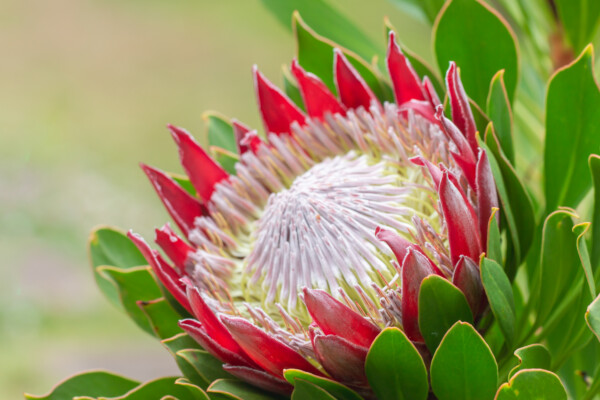
Close up of King protea
2. Erica empetrina
If you spot a small shrub covered in pink or reddish flowers, take a closer look. You may have found something that grows nowhere else in the world.
Erica empetrina, commonly known as crowberry heath, is endemic to the Cape Peninsula and is commonly found on Table Mountain at elevations above 600 metres. Its flowering period runs from spring into summer, making the warmer months a particularly good time to start looking for it.
It is a relatively small shrub, growing to around 30 cm high, with dense grey-green foliage and clusters of tubular pink to red flowers.
Its habitat is just as interesting as the flower itself. It grows in rocky areas as well as sandy, damp or marshy places in sunny, open environments, exactly the kind of specialised habitat that makes the Cape’s fynbos so diverse.
Where to look: Higher, open sections of Table Mountain, particularly around rocky areas.
Want to see it for yourself?
Head over to SANBI’s PlantZAfrica page for Erica empetrina.
3. Pincushions
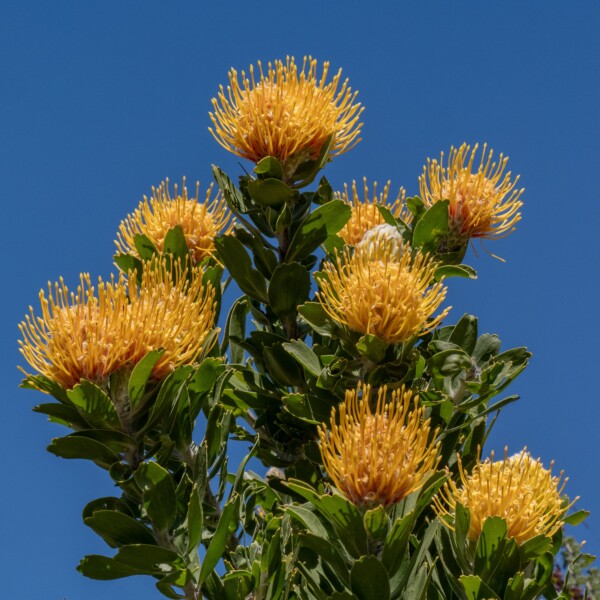
With their strange, spiky-looking flower heads, pincushions (Leucospermum species) are another unmistakable member of the Proteaceae family.
Their long styles extend out from the flowers, creating the characteristic pincushion appearance. They aren’t just there to look spectacular, either. Their flowers are adapted for pollination by animals, with nectar attracting birds and insects.
Pincushions are part of what makes walking through Cape fynbos so interesting: the plants can look unusual and sometimes almost alien compared with the vegetation visitors might be used to seeing elsewhere in the world.
Silvermine is an excellent place to explore this kind of vegetation. SANParks describes the area as having some of the Park’s best hikes through beautiful fynbos landscapes, with its trails passing through a remarkable diversity of plant life.
Where to look: Silvermine and other areas of open, flowering fynbos.
4. Trachyandra
Some of Table Mountain’s most interesting flowers aren’t found growing amongst the open fynbos at all. They cling to the mountain itself.
Trachyandra tabularis, commonly known as the Table Mountain cliff trachyandra, is an unusual plant found only on the damp, south- and east-facing sandstone cliffs of Table Mountain and neighbouring mountains. It is a true cliff specialist, growing from cracks and crevices at higher elevations where the conditions are cool, shady and moist.
In spring and summer, it produces slender flower stalks carrying small, white, sweetly scented flowers. Look closely and you may notice insects visiting the blooms – they are the plant’s main pollinators.
Its unusual habitat is actually part of what protects it. Growing on sheer cliffs makes the plant difficult for larger herbivores to reach, allowing it to form dense clusters in some areas.
Where to look: The cliffs and kloofs of Table Mountain, particularly damp, south-facing sandstone cliffs at higher elevations.
Want to see what it looks like? SANBI’s PlantZAfrica page has photographs and more information about the Table Mountain cliff trachyandra.
Which Table Mountain Trails Are Best for Flower Spotting?
When it comes to seeing Table Mountain’s incredible plant life, the route you choose can make a difference. Different parts of the mountain offer different habitats, and some trails are particularly rewarding if you’re interested in fynbos and flowers.
Kasteelspoort
Kasteelspoort is a great choice for flower spotting, particularly when the proteas are in bloom. The route climbs the western slopes of Table Mountain through fynbos, with the added bonus of spectacular views across the Atlantic and Twelve Apostles.
Keep an eye out for King Proteas and other flowering fynbos along the way.
Silvermine
If flowers are your main motivation, Silvermine is one of the best places to start. Its network of trails passes through extensive fynbos, with options ranging from easier walks to more challenging hikes.
The area is particularly interesting for anyone wanting to appreciate the sheer variety of plants found within Table Mountain National Park.
Skeleton Gorge
Starting in the lush surroundings of Kirstenbosch before climbing into the mountain, Skeleton Gorge offers an incredible variety of vegetation along the route.
The changing landscape, from forest into higher mountain fynbos, means there is plenty to look out for as you climb. It’s a great option for seeing how the vegetation changes with altitude and habitat.
Ready to see Cape Town’s wild side? Join AWOL Tours on a Table Mountain hike and let one of our local guides introduce you to the plants and stories that make this mountain so special.
 We're on WhatsApp!
Leave A Comment